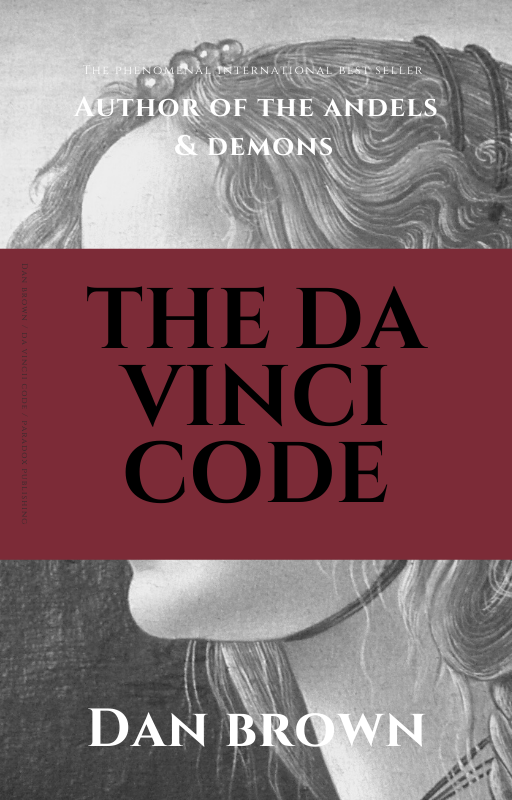
1. Book Cover
2. Summary
Jacques Saunière, the revered curator of the Louvre museum in Paris, is shot cruelly by an albino monk looking for a certain mysterious something that only Saunière and three other men could lead him to.
Realizing the secret that he and those other men vowed to protect is about to die with him, Saunière scrambles to leave behind a message that very specific people can only understand.
Robert Langdon, a modest but excellent Symbology professor, gets summoned to a gruesome murder scene in the middle of the night because the DCPJ (French version of the FBI) wants his expert opinion. Upon arrival, Langdon is shocked to learn that the victim is Jacques Saunière—incidentally, the very man he was supposed to meet earlier that night for drinks.
Captain Bezu Fache of the DCPJ likes Langdon to be the prime suspect in Saunière’s death, and all he needs is confession at the crime scene. However, He is blocked in getting one, because Sophie Neveu (the alienated granddaughter of Saunière and code-breaker) interrupts the process and cleverly warns Langdon that he is in serious trouble.
The two of them manage to escape the Louvre without being caught by the police, but not before they find an array of clues left behind by her grandfather.
Sophie and Langdon are led from there on a crazy quest to find the keystone—a mysterious object that will ultimately lead to the Holy Grail. Turns out Saunière had been the head of a secret society known as the Priory of Sion that venerates the sacred feminine preserves the secret of the true identity and position of the Holy Grail.
The holy grail is not a wooden cup but Mary Magdalene’s bones, and documents proving she was the mother of children of Jesus. Now it’s up to Sophie and Langdon to comprehend Saunière’s clues and discover the mystery he has been working so hard to secure.
Along the way, they sought the help of the Grail specialist Sir Leigh Teabing while escaping capture by the DCPJ and attacks from the albino monk, Silas. Together they tried to decipher Saunière’s riddles and find answers.
As things unfold, it turns out that the shadowy figure known as the Teacher orchestrated the whole charade. He is the one who ordered Silas to kill Saunière, and also pulled the strings behind Silas’s mentor—the poor Bishop Aringarosa—as well, who is a man struggling to save his conservative Catholic sect Opus Dei from extinction.
In a surprise no one sees coming, Robert Langdon finds out that Teabing is the aforementioned Teacher, just as he deciphers the final clue. Captain Bezu Fache manages to save the day, with the accuracy of a Swiss watch. He realized he had accused the wrong person thanks to a confession from the sheepish Bishop who just knew he and Silas had been used, and he manages to track down and arrest Teabing just in time.
Langdon and Sophie travel to Rosslyn Chapel in Scotland with their names cleared of any offences, and the final clue solved. According to Saunière’s last riddle, they will supposed IIly find the Holy Grail there. But instead, they discover the long-lost grandmother and little brother of Sophie, who also happens to be direct descendants of Jesus Christ and Mary Magdalene.
Sophie is very glad to finally have family knowing that her parents died mysteriously when she was young. Langdon, on the other hand, is rather disappointed that he did not end up finding the Grail.
Luckily, with the aid of the grandmother, Saunière’s wife, Langdon pieces together Saunière’s final clue in a different way, and is struck by the realization that the Holy Grail actually lies beneath the Louvre itself.
- Characters and Characterization
a.) Langdon – Confident
“Langdon turned to face his sea of eager students. ‘ who can tell me what this number is?’”
b.) Sophie Neveu – Critical-minded
“The Fibonacci sequence? The P.S.? All the Da Vinci and goddess symbolism? That had to be my grandfather.”
c.) Silas – Albino
“’You are as white as a ghost,’ the inmates ridiculed as the guards marched him in naked and cold.”
d. Bezu Fache – professional
“I am witnessing the work of a master……., Fache will do what no one else dares,” mused Lieutenant Collet. Pp.71
e.) Sir Leigh Teabing – treacherous
“There was no viable response, Landon knew. Answer yes, and he would be selling out Sophie. Answer no, and Teabing would have no choice but to kill them both.” Pp. 546
- Setting
Louvre Museum, Paris
The Louvre Museum was the location they were trying to find. It was the place where the story began and it is also where it ended. The place said to be the burial place of Mary Magdalene.
- Three Themes
a.) The Sacred Feminine
On one level, the main characters in this novel are discussing and searching for symbolic representations of the sacred feminine. However, on another, more subtle, level Brown portrays women’s power. Through Sophie Neveu, Brown illustrates an intelligent and capable woman. Moreover, Sophie frequently makes decisions based on a sixth sense not bestowed upon the male characters which Brown calls women’s intuition. Sophie’s feminine power is reinforced by the many stories told of ancient reverence for women as life-givers as well as the prominent status of Mary Magdalene.
b.) Fanaticism
While this novel promotes faith, it also cautions against pursuing one’s beliefs to the point of fanaticism. Brown offers two examples of characters that become fanatics: Silas and Teabing. Silas is a religious fanatic. He allows his desire to please God and act on behalf of the Church to cloud his judgment. Silas is willing to murder as long as he believes he is supporting the Church.
Similarly, Lee Teabing believes so strongly in finding and revealing the Sangreal documents that he is willing to murder for his cause. While each of these men fanatically supports diametrically opposed agendas, they both come to believe that the ends justify the means. Brown seems to admonish this behavior because neither fanatical character is successful.
c.) The conflict between religion and science
“Dan Brown refuses to accept the idea that faith in God is rooted in ignorance of the truth. The ignorance that the Church has sometimes advocated is embodied in the character of Bishop Aringarosa, who does not think the Church should be involved in scientific investigation. According to The Da Vinci Code, the Church has also enforced ignorance about the existence of the descendents of Jesus. Although at one point in the novel Langdon says that perhaps the secrets of the Grail should be preserved in order to allow people to keep their faith, he also thinks that people who truly believe in God will be able to accept the idea that the Bible is full of metaphors, not literal transcripts of the truth.”
- Figures of Speech
a.) Onomatopoeia – Sophie nodded, having to smile at the burping sound of the water gurgling through their throats. Pp303
b.) Simile – His arms and legs were sprawled outward in a wide spread-eagle, like those of a child making a snow angel. Pp55
c.) Simile – He felt for an instant like a modern-day Moses. pp.174
d.) Hyperbole – By officially endorsing Jesus as the Son of God, Constantine turned Jesus into a deity who existed beyond the scope of the human world, an entity whose power was unchallengeable. Pp312.
e.) Metaphor – The Holy Grail is a woman, Sophie thought, her mind a collage of interrelated ideas that seemed to make no sense. Pp323
- Sensory Images
a.) Visual – Fifty yards ahead, the traffic light at Rivoli turned red. Pp.187
b.) Tactile – Langdon felt his muscles tighten. Pp. 187
c.) Visual – Napoleon’s 164-foot-tall tribute to his own military potency – encircled by France’s largest rotary, a nine lane behemoth. Pp. 198
d.) Visual – Ahead of them, the glass-roofed train terminal resembled the awkward offspring of an airplane hangar and a greenhouse. Pp. 199
e.) Tactile – The altar boy felt his groin grow hot and realized he had wet himself. Pp. 469
- Favorite Lines
a.) “Men go to far greater lengths to avoid what they fear than to obtain what they desire.” Pp353 – We may want to disagree but it undeniably true that a desperate man would do everything to conceal his flaws while it is ironically difficult for men to make sacrifices to get his desires in life.
b.) “What is history, but a fable agreed upon?
By its very nature, history is always a one sided account.” Pp. 340
- As others say, we can not guarantee the accuracy of information we see from our pasts because the dark ages were very conflicted with power. And those who wins authority has the capabilities to manipulate its people and influence them to its desire by any means.
c.) “In the end, which side of the story you believe becomes a matter of faith and personal exploration.” Pp340 – Many of us believe in what we want to or what is compatible with our perceptions in life and our choice of beliefs define us as an individual.
d.) “Judge man’s civility not by his compassion for his friends but by his compassion for his enemies.” Pp380 – Indeed, I agree because a man’s level of spirituality depends on how he deal with negativities in his life. A man’s true nature are seen when the table is not in his favor.
e.) “Blinding ignorance does mislead us. O! Wretched mortals, open your eyes! – Leonardo da Vinci” Pp309 – This line captured my interest because we live in a world full of beliefs and most of it hold blind faiths. We close our eyes from what is already present and looks forward to what is uncertain.

 Novel Analysis of The Da Vinci Code